Calypso and Carnival
Introduction: What is Calypso? What is Carnival? How do they relate to Vieques and St. Croix?
Calypso first originated in Trinidad, in the southeastern part of the Caribbean, near South America. Derived from West African traditions brought to the Caribbean by enslaved people, Calypso, or kaisos, "were performed by a griot or chantwell, a local bard who told stories in song, offering social commentary through praise, satire or lament. Their lyrics often mocked slave masters and would be recited at the harvest festival of Canboulay, a parallel with the pre-Lent Carnival, from which even freed slaves were barred. In 1881, percussion was banned by the British colonial authorities, which resulted in the innovation of steel pan music, initially consisting of frying pans, dustbin lids and oil drums.” [1] Although calypso is often performed during carnival and conveys joy, its content, as its origins illustrate, also engages with the wider socio-political landscape. From commenting on local Trinidadian politics, to racial segregation in the U.S. South, to critiques of Britain, calypso music has covered a wide range of topics that engage with fraught socio-political and racialized realities in contemporary times. [2]
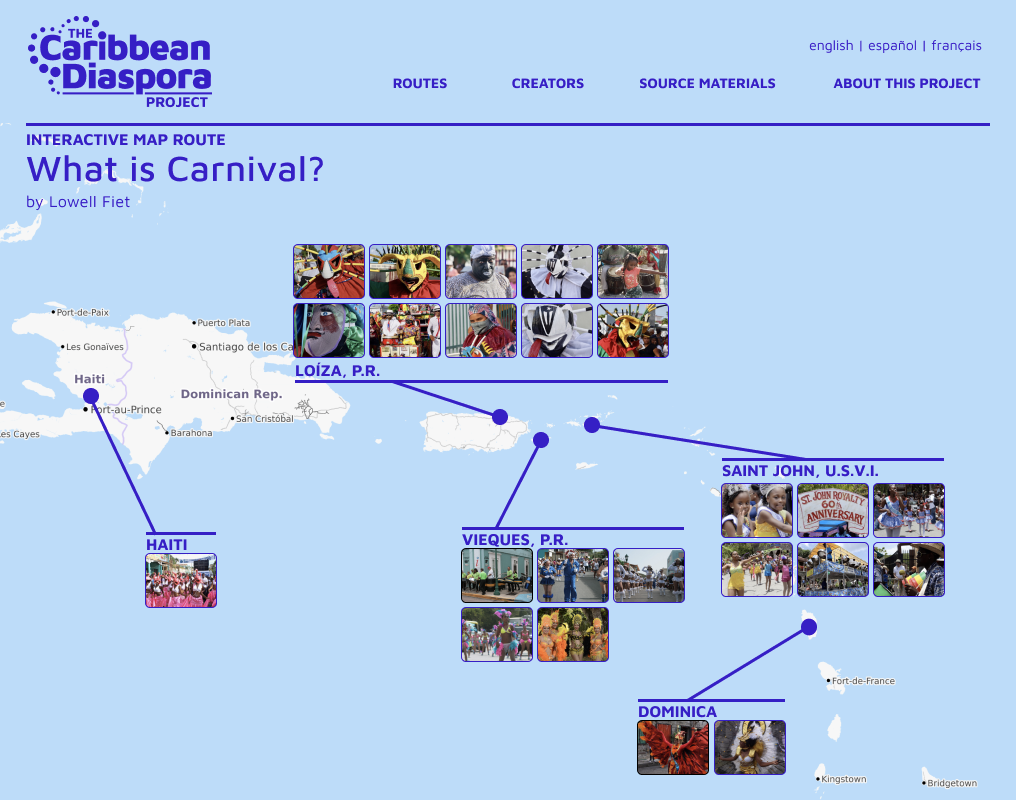
Carnival throughout the Caribbean takes on many forms, converging several traditions across religions, continents, and historical periods. Carnival celebrations “revolve around processions, masks, masquerade characters, music, song, dance, feasting, drinking, and sensuality.” [3] Carnival—religious to some and sacrilegious to others—is a collective celebration that peppers the entire Caribbean, each carnival commemorating saints, independence, and other culturally significant traditions (Figure 1). Although highly commercialized in some respects, carnival, as this project understands it, is a collective and durational performance that embodies knowledge, memory, affect, and transmits a spiral-like embodiment of history—one in which the past is reconfigured and performed in the present and informs the future.
Carnivals—like those celebrated in the USVI and Vieques—often includes calypso music. How did calypso, however, arrive in Vieques? According to Nadjah Ríos-Villarini's interviews with local Viequense musicians, calypso arrived through the U.S. Virgin Island of St. Croix. In 1957, the mayor of Vieques invited a senator from the USVI who brought a children's steel band. [4] The mayor of Vieques then invited a steel band music teacher who resided in the USVI but was originally from Trinidad to teach Viequense children how to play steel drums. [5] From then on, multiple calypso bands formed in Vieques. These bands were heavily influenced by calypso bands from the USVI, including Imagination Brass from St. Croix and Seventeen Plus from St. Thomas. [6]
Viequense calypso bands were hired by the municipal government to play at the Patron Saint Festival celebrations, which includes a carnival on its last day. [7] Crucians would travel to Vieques for carnival and vice versa—some to partake in the festivities and others to play calypso music. [8] Through Vieques and its neighboring island municipality, Culebra, calypso reached the main island of P.R. Bands like Vieques Calypso Brass performed on television, inviting everyone to Vieques’ carnival (refer to first video below). Similarly, Orquesta Panamericana's 1961 song "Beautiful Girl" features the revered Puerto Rican singer, Ismael Rivera, singing to the cadence of calypso-reminiscent rhythms about a beautiful girl he wishes would come with him to St. Croix (refer to second video below).
Carnival and calypso became a bridge between P.R., the USVI, and the Eastern Caribbean. In this way, calypso and carnival disrupt the coloniality that often creates divisions along racio-linguistic borders between the Hispanic Greater Antilles and the Anglophone and Francophone Lesser Antilles. Its distinctive percussion sound, although often produced electronically today, evokes the steel pan music enslaved people under British colonial rule turned to when faced with the ban of percussion by colonial authorities. Empire—past and present; British, French, Spanish, and American—connects the Caribbean. Although communities throughout the Caribbean have experienced empire in differing gradations, producing incommensurable struggles, this shared history also provides fertile ground for a more rigorous solidarity that understands liberation is intertwined.
Focusing on Vieques and St. Croix, calypso and carnival unveil a connection that runs much deeper than geographic proximity. Calypso and carnival repeatedly perform solidarity, consciously and unconsciously. These performances enact and rehearse a deeper intra-colonial connection in the periphery of empire.
Vieques Calypso Brass (1986) - My Donkey
Orquesta Panamericana (1961) - Beautiful Girl
Notes:
[1] Benjamin Ramm, “The Subversive Power of Calypso Music,” BBC, October 11, 2017, https://www.bbc.com/culture/article/20171010-the-surprising-politics-of-calypso.
[2] Ibid.
[3] “What Is Carnival? Micro-Project,” The Caribbean Diaspora Project, n.d., https://caribbeandiasporaproject.org/phase-1/phase-1-pilot-micro-projects/what-is-carnival-micro-project/.
[4] Nadjah Ríos-Villarini, “Desde Trinidad a Vieques vía Islas Vírgenes: Breves apuntes sobre la historia del calipso y las bandas de drones en la isla municipio,” Revista Cruce, 2015.
[5] Ibid.
[6] Ibid.
[7] Ibid.
[8] Sugar Pathways, Documentary, directed by Johanna Bermúdez-Ruíz, 2010.